
Stormwater Compliance · Commercial Properties · Pittsburgh Metro
The Feature at the Back of the Property That Creates Front-Page Problems
Retention ponds sit behind the building, past the dumpsters, out of sight. Property managers think about them once a year during the stormwater inspection. By then, sediment has built up along the inlet, vegetation has overtaken the basin perimeter, and the outlet structure has a partial blockage.
Max cost of emergency sediment dredging
Quarterly maintenance visits per year
Forebay capacity threshold triggering cleanout
The inspector writes a deficiency notice. The property manager scrambles to find a contractor who can fix the problem before the follow-up visit. That contractor charges emergency rates. This cycle repeats on commercial properties across Pittsburgh because retention ponds do not look like they need maintenance until they fail. A quarterly schedule prevents the scramble and keeps your stormwater features compliant year-round.
PA DEP Requirements: Your Pond Is Your Responsibility
Pennsylvania’s stormwater management regulations require commercial property owners to maintain post-construction stormwater BMPs in working condition. Retention ponds, detention basins, and bioretention facilities fall under this mandate. Your property’s stormwater management plan specifies the maintenance requirements for each feature.
→ See our full drainage services
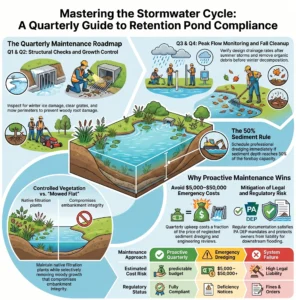
The Quarterly Maintenance Cycle
Jan – Mar
Check inlet and outlet structures for ice damage. Remove accumulated debris from grates and overflow spillways. Assess bank erosion from freeze-thaw cycles. Document sediment depth at the forebay and main basin. Record everything for your compliance file.
Apr – Jun
Mow basin perimeter vegetation to maintain access for inspection. Remove invasive species before they establish root systems. Check for clogged low-flow orifices. Inspect the emergency spillway for blockages. This is the quarter where prevention saves the most money.
Jul – Sep
Heavy summer rainfall pushes sediment into the basin and stresses outlet structures. Walk the site after major storms. Clear floating debris. Verify that the pond drains at the design rate. A pond that holds water longer than the design specification needs outlet maintenance, not another mowing visit.
Oct – Dec
Remove leaves and organic debris before they decompose and add nutrient load to the water. Final mowing of basin perimeter. Annual sediment depth measurement. Compare sediment levels to the maintenance threshold in your stormwater plan. If sediment exceeds 50% of the forebay capacity, schedule a cleanout for the next dry-weather window.
→ Learn about our retention pond maintenance service
Vegetation: Controlled Growth, Not No Growth
Retention pond basins need vegetation. Grass and native plantings along the banks stabilize soil and filter sediment from incoming runoff. The problem starts when growth goes unchecked.
- Woody plants root into the embankment and compromise the structural integrity of the berm
- Dense brush blocks access for inspection crews
- Volunteer trees drop leaves into the basin and add organic load that accelerates algae growth
GSL maintains retention ponds with a controlled vegetation program: regular mowing of the basin perimeter, selective removal of woody growth on the embankment, and preservation of native plantings that serve a filtration function. We treat the basin as a functioning stormwater feature. Your property gets treated, not mowed flat.
Most Landscapers Skip This Work. Here’s the Reason.
Retention pond maintenance requires equipment that can access soft, sloped terrain around the basin perimeter. It requires knowledge of stormwater design intent so the crew does not mow vegetation that serves a filtration purpose. It requires documentation that satisfies an inspector.
GSL maintains retention ponds for commercial properties and industrial sites across the Pittsburgh metro area. Our crews understand the difference between a landscaping task and a compliance task. Your retention pond gets treated as both.
The Cost of Ignoring Your Pond
Emergency sediment dredging
Quarterly maintenance program
- Engineering review from the conservation district adds several thousand dollars on top of dredging costs
- Corrective planting and erosion repair on damaged embankments adds more
- A failed pond during a major storm event sends uncontrolled runoff onto neighboring properties — the property owner carries the legal exposure
Compare that to quarterly inspections, targeted mowing, and annual sediment measurement. The proactive program runs a fraction of a single emergency intervention.
Schedule a retention pond inspection with GSL. We serve commercial properties and industrial sites across the Pittsburgh metro area.
(412) 310-4554
Request an inspection at gslpgh.com/contact