
Grounds Maintenance for Industrial Parks: The Facility Manager’s Playbook for Warehouses and Distribution Centers
Warehouse Landscaping Is a Scheduling Problem Disguised as a Mowing Job
An industrial park does not operate on the same schedule as a corporate office. Tractor-trailers begin arriving before sunrise. Loading docks remain active through lunch. Employees enter and leave during shift changes. Delivery lanes, staging areas, and trailer lots may be in use every hour of the day. A landscaping crew that arrives without understanding those patterns creates problems.
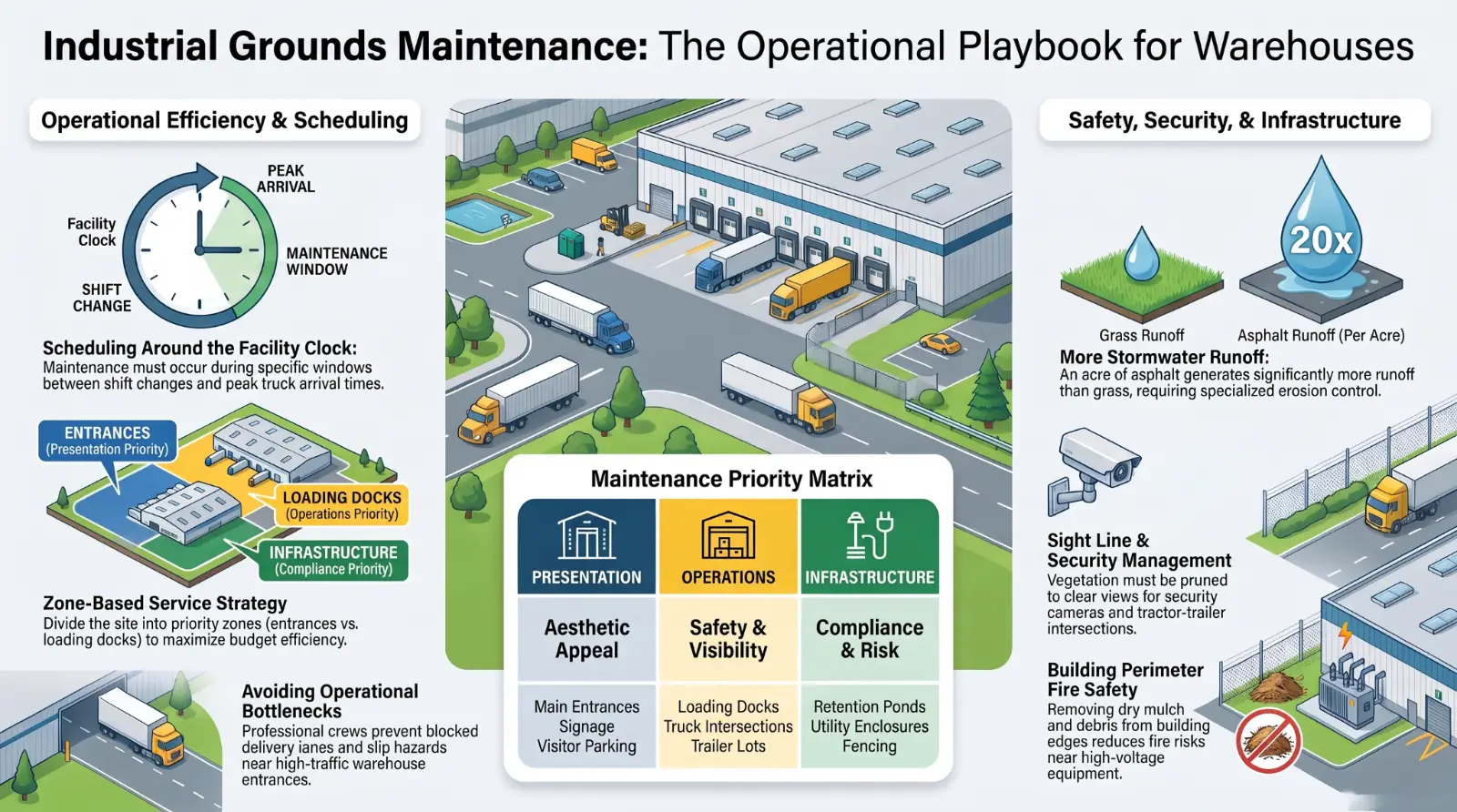
A truck and trailer parked beside a loading dock can block a delivery route. Grass clippings left near a warehouse entrance can create a slip hazard. Tall vegetation at an intersection can block a driver’s view of approaching traffic. Mowing during a shift change can put employees and equipment in the same crowded area.
Grounds maintenance for warehouses and distribution centers must be designed around truck routes, loading activity, security requirements, stormwater systems, and the hours when crews can safely work.
Growing Seasons Landscaping provides industrial park landscaping and warehouse grounds maintenance for large commercial and industrial properties throughout Pittsburgh and Western Pennsylvania.
This playbook outlines the areas facility managers should address when building an effective grounds maintenance program.
Eleven Areas Every Grounds Program Should Address
Build the Maintenance Schedule Around Operations
The first question should not be, “What day do you mow?”
It should be, “When can you work without interfering with operations?”
Every industrial property has different traffic patterns. One distribution center may receive the highest volume of trucks between 4:00 and 8:00 a.m. Another may run three shifts with only a short window of reduced activity in the afternoon. A warehouse may reserve certain doors for priority deliveries or use different trailer lots throughout the week.
Before maintenance begins, the landscaping contractor should understand:
- Truck arrival and departure patterns
- Shift-change times
- Loading dock schedules
- Delivery and staging lanes
- Restricted-access areas
- Employee parking patterns
- Pedestrian routes
- Emergency access points
- High-volume days
- Seasonal operational changes
The grounds schedule should then be divided into service zones. Entrance landscaping may be maintained during one window. Dock areas may require work during a quieter period. Remote perimeter mowing may happen while loading areas are active because it does not interfere with truck movement.
This planning protects both productivity and safety.
That distinction becomes especially important when one blocked lane delays multiple deliveries or forces trucks to back through a crowded area.
GSL assigns clients a dedicated Account Manager who learns the property’s priorities and coordinates work around the site’s operating schedule.
Keep Truck Routes and Intersections Visible
Visibility affects every driver moving through an industrial park.
Tractor-trailers require more space and more time to stop than passenger vehicles. Drivers also navigate wide turns, blind corners, trailer staging areas, and intersections shared with employees and visitors.
Vegetation that would be a minor nuisance at an office property can become a significant hazard at a warehouse.
Common visibility problems include:
- Shrubs blocking views at internal intersections
- Tall ornamental grasses near entrance drives
- Tree branches obscuring signs
- Vegetation growing around directional markers
- Brush along security fencing
- Weeds blocking curbs or pavement edges
- Branches interfering with lighting
- Overgrowth around loading dock approaches
The solution is not simply to prune everything into small shapes.
The contractor should identify sight triangles at entrances and intersections, then maintain vegetation at heights that preserve visibility. Plants that repeatedly outgrow those limits may need to be replaced with more appropriate varieties.
Loading areas deserve specific attention. Drivers need clear views of dock numbers, traffic signs, pedestrians, and other vehicles while maneuvering.
Security teams also depend on predictable visibility around cameras, fences, gates, and remote portions of the property.
A strong vegetation plan protects those sight lines through scheduled pruning, selective removals, and routine inspections.
Control Pavement-Edge Erosion Before It Damages the Lot
A warehouse or distribution center may contain acres of roofs, parking lots, trailer areas, and access roads.
All of those hard surfaces shed water.
An acre of pavement can generate dramatically more runoff than an acre of healthy grass because very little water soaks into the ground. During a heavy Pittsburgh storm, that runoff moves quickly toward curbs, drains, swales, and the edges of paved areas.
When those transitions are not maintained, water begins cutting away the soil beside the pavement.
At first, the damage may look like a narrow gap along the curb. Over time, runoff carries away more soil, undermines the pavement edge, and creates cracking or settlement.
Warning signs include:
- Exposed pavement edges
- Channels forming beside roads
- Soil washing across pavement
- Mulch collecting in drains
- Standing water near curbs
- Sinking landscape islands
- Gravel washing out of access roads
- Bare slopes below parking areas
- Sediment collecting near stormwater structures
These issues should not be treated as isolated landscaping defects.
They indicate that water is not moving through the site as intended.
The fix may involve regrading, adding topsoil, restoring turf, installing erosion-control material, clearing drainage structures, hydroseeding, or stabilizing the slope below the pavement.
GSL provides drainage support, erosion control, hydroseeding, slope stabilization, runoff mitigation, and site restoration for large industrial properties.
That gives facility managers access to more than a mowing crew when the edge of the property begins to fail.
Maintain Stormwater Systems as Facility Infrastructure
Retention ponds, detention basins, bioswales, drainage channels, and outlet structures are part of the property’s infrastructure.
They should not be treated as leftover green space.
Large warehouse developments generate significant runoff. If a stormwater feature becomes blocked or overgrown, water can back up into parking areas, erode slopes, damage access roads, or create compliance concerns.
An industrial grounds program should include routine attention to:
- Retention and detention ponds
- Inlet and outlet structures
- Drainage swales
- Culverts
- Catch basins
- Emergency spillways
- Rain gardens
- Vegetated slopes
- Low areas beside parking lots
- Sediment collection points
Crews should know the difference between helpful vegetation and harmful overgrowth. Grass and native plants can stabilize soil and filter runoff. Woody plants growing through an embankment may compromise its integrity. Dense brush can block inspections. Volunteer trees can interfere with drainage structures.
Simply mowing the perimeter does not constitute stormwater maintenance.
The contractor should inspect access conditions, control unwanted growth, report blockages, and identify erosion before it becomes severe.
GSL maintains retention ponds and other stormwater areas for commercial and industrial clients throughout the Pittsburgh region.
Select Plants That Can Survive Parking Lots
Parking lot islands are among the most difficult planting environments on a warehouse property.
They are surrounded by pavement that absorbs and radiates heat. Snow is piled on them during winter. Salt spray reaches the soil. Drivers run over curbs. Compacted ground limits root development. Irrigation may be inconsistent or nonexistent.
Plants selected only for appearance often fail.
Facility managers then pay repeatedly for replacements, cleanup, watering, and pruning.
Landscape plants used around warehouse parking lots should be chosen for their ability to tolerate:
- Road salt
- Heat
- Drought
- Compacted soil
- Snow storage
- Limited root space
- Vehicle exhaust
- Wind exposure
- Irregular maintenance conditions
Tree placement also matters.
A tree that grows too large for an island can damage curbs and pavement. Low branches can interfere with trucks, signage, and lighting. Trees placed near security cameras may eventually block the view.
The goal should be durable, predictable landscaping that supports the property rather than adding another recurring problem.
In some areas, turf or decorative beds may not be the best option. A stabilized, low-maintenance planting plan may provide a cleaner result with less irrigation and replacement work.
GSL installs trees, shrubs, turf, and groundcover based on the site conditions and long-term maintenance demands of the property.
Treat Snow Storage as Part of the Landscape Plan
Snow removal affects the landscape long after winter ends.
Industrial sites require large snow-storage areas because access roads, dock approaches, employee parking lots, fire lanes, and trailer areas must remain usable.
When snow is pushed into the wrong location, it can create several problems:
- Broken shrubs and trees
- Salt damage
- Blocked drainage structures
- Flooding during snowmelt
- Reduced visibility at intersections
- Obstructed cameras
- Damaged curbs
- Compacted soil
- Delayed spring cleanup
- Piles that interfere with trailer movement
The grounds and snow plans should be coordinated before winter.
Facility managers should identify where snow can be stored without affecting drainage, visibility, emergency access, or valuable plant material.
Parking lot islands that receive snow should contain salt-tolerant, durable plants—or be designed without vulnerable landscaping.
The spring maintenance plan should also account for winter damage. Crews may need to remove gravel from turf, repair plow damage, restore compacted soil, replace plants, and clear debris from drainage areas.
When the landscape contractor and snow contractor are the same company, responsibility is clearer. The team understands where plantings, drainage structures, and sensitive areas are located before the first storm.
GSL provides year-round landscape maintenance and snow and ice management for commercial and industrial facilities.
Reduce Fire Risk Along Building Perimeters
Dry organic material can create unnecessary fire risk around industrial buildings.
Mulch, leaves, dead weeds, and dry ornamental grasses may accumulate beside walls, loading areas, equipment, or utility zones. Cigarette disposal, vehicle activity, hot equipment, or an electrical issue can provide an ignition source.
Mulch should not be continually added without accounting for the material already present. Deep mulch layers can hold heat, trap moisture against the building, cover drainage paths, and create an untidy edge.
In higher-risk areas, stone or another noncombustible surface may be more appropriate than organic mulch.
The contractor should coordinate with the facility’s safety team to identify building perimeters, generator areas, utility equipment, smoking areas, and loading zones that require additional attention.
This is another example of why industrial landscaping must be connected to facility operations.
A neat planting bed is not enough if the material within it creates a preventable risk.
Protect Fences, Cameras, and Security Zones
Warehouse and distribution properties often include large perimeter fences, gated access points, cameras, lighting, and controlled entry areas.
Vegetation can interfere with all of them.
Vines may grow through fencing. Brush can hide fence damage. Tree limbs may contact security equipment. Tall grass can obscure the base of a fence during inspections. Dense plantings may create concealed areas near the property line.
A security-focused maintenance plan should define clear zones around:
- Perimeter fencing
- Cameras
- Gates
- Guard stations
- Lighting
- Emergency exits
- Utility enclosures
- Fire department connections
- Signage
- Pedestrian access points
These areas may require more frequent attention than remote parts of the property.
Crews should also report unusual conditions, including damaged fencing, dumped debris, fallen branches, or evidence of unauthorized access.
The landscaping contractor may visit remote portions of the property more often than members of the facility team. That makes the crew an additional source of site observations when communication procedures are in place.
Separate High-Visibility Areas From Industrial Work Zones
Not every acre of an industrial park needs the same level of care.
The visitor entrance, office frontage, and employee areas may require a polished commercial appearance. Remote perimeters and utility areas need controlled, functional vegetation. Stormwater zones require selective maintenance. Loading areas need clear sight lines and debris control.
Dividing the property into service zones creates a more efficient program.
Entrances, signage, office frontage, and visitor parking that receive frequent mowing, edging, pruning, and cleanup.
Loading docks, trailer lots, employee access routes, and truck intersections where safety and visibility take priority.
Fences, gates, cameras, lighting, and inspection paths requiring controlled vegetation.
Generators, utility equipment, fire connections, drainage structures, and access pads that must remain clear.
Retention ponds, swales, slopes, and other areas managed for drainage, erosion control, and compliance.
Remote acreage that may need scheduled mowing, invasive-species control, or naturalized vegetation rather than weekly detail work.
This approach allows the maintenance budget to be directed where it produces the greatest operational and visual benefit.
It also gives crews clear expectations for each part of the property.
Demand Communication Before Problems Reach Your Desk
Facility managers should not be the first people to notice every grounds issue.
The landscaping contractor is already moving throughout the site. Crews should report conditions that affect safety, access, drainage, security, or future costs.
That includes:
- Broken branches
- Blocked drains
- Erosion
- Standing water
- Damaged curbs
- Failed plant material
- Overgrown sight lines
- Fence damage
- Fallen signs
- Dumped debris
- Irrigation leaks
- Snow or storm damage
The reporting process does not need to be complicated.
Photos, a clear description, the location, and a recommended next step give the facility manager enough information to make a decision.
The account manager should also help plan upcoming work rather than waiting for emergency requests. Seasonal reviews can address spring repairs, summer growth, fall cleanup, snow preparation, capital improvements, and changes in site operations.
GSL clients receive a dedicated Account Manager and a response within 24 business hours. This gives facility teams a direct, local point of contact who knows the property and can coordinate with field crews.
Confirm That the Contractor Has Industrial Capacity
A warehouse may look like a large lawn to an inexperienced contractor.
In practice, it requires equipment, scheduling flexibility, trained crews, safety procedures, and enough field capacity to recover after weather delays.
Before hiring a contractor, ask:
- Have you maintained active warehouse or industrial properties?
- Can you schedule around truck traffic and shift changes?
- Do you have equipment for large acreage and slopes?
- Can you maintain retention ponds and drainage areas?
- Are crews trained for restricted or high-traffic environments?
- Can you provide snow and ice management?
- Do you carry industrial safety credentials?
- Who will manage our account?
- How do you document and report problems?
- Can you respond when weather disrupts the normal schedule?
GSL serves industrial properties, utility companies, natural gas producers, solar farms, commercial campuses, and other large-scale sites.
Our teams maintain compliance through ISN Networld, Veriforce, and Safeland and are accustomed to environments where contractor safety and communication matter.
Veriforce
Safeland
A Year-Round Industrial Grounds Maintenance Checklist
A complete program should account for seasonal demands.
Repair plow and salt damage
Clear drainage structures
Restore eroded pavement edges
Begin mowing and vegetation control
Clean parking lot islands
Inspect retention ponds and swales
Refresh appropriate planting beds
Repair failed turf
Maintain security and traffic sight lines
Monitor drainage after heavy storms
Control vegetation around fences and equipment
Mow large turf and perimeter areas
Remove dry debris near buildings
Inspect slopes for erosion
Maintain parking lot islands
Remove leaves from drains and loading areas
Complete final pruning and mowing
Clear stormwater structures
Remove dead plant material
Review snow routes and storage areas
Inspect trees near roads and parking lots
Prepare entrances and pedestrian areas for winter
Keep truck routes and loading areas accessible
Clear emergency access points
Deice employee and pedestrian areas
Protect cameras, gates, and drainage from snow piles
Monitor snow-storage capacity
Respond to fallen branches and storm debris
A written annual plan gives facility managers, contractors, and field crews the same expectations.
Choose a Landscaping Partner That Works Around Your Facility
Industrial park landscaping is not residential maintenance on a larger lot.
A successful program must account for truck traffic, loading operations, shift changes, security systems, stormwater infrastructure, snow storage, erosion, and the safety of everyone moving through the property.
Growing Seasons Landscaping provides warehouse grounds maintenance and distribution center landscaping services across Pittsburgh and Western Pennsylvania.
Our capabilities include:
- Commercial landscape maintenance
- Large-acreage mowing
- Slope and right-of-way mowing
- Vegetation management
- Retention pond maintenance
- Drainage and erosion control
- Hydroseeding and site stabilization
- Landscape installation
- Gravel road maintenance
- Snow and ice management
- Additional industrial and environmental services
As the Pittsburgh metro area’s largest privately owned commercial and industrial landscaping company, GSL provides the crews, equipment, systems, and local leadership required to support demanding facilities.
Request an Industrial Facility Site Assessment
A site assessment allows a GSL Solutions Specialist to review your traffic patterns, loading zones, stormwater systems, security areas, landscape conditions, and seasonal priorities.
You will receive recommendations based on how the property actually operates, not a generic mowing package.
Request an Industrial Facility Site Assessment
Call (412) 310-4554 or fill out the contact form at gslpgh.com/contact to request an assessment for your warehouse, distribution center, or industrial park.
(412) 310-4554
Visit gslpgh.com/contact